Heat Pump Installation in Birstall, Leicester
MCS-certified air source heat pump installation across Birstall's Edwardian railway-era stock, the post-war estates, and the village conservation core — covered by Charnwood Borough Council planning, not Leicester City. £7,500 BUS grant supported.
Last reviewed: 21 May 2026
-
£7,500 BUS grant
available toward an MCS-certified heat pump installation in Birstall. Statutory figure — gov.uk Boiler Upgrade Scheme.
-
MCS-certified installation
is required for the BUS grant and to protect manufacturer warranty terms. Every installer in our network is MCS-certified.
-
~3–4× the efficiency of a gas boiler
in typical UK conditions, measured by SCOP across a full heating season. Leicester's design winter temperature is around −3.6°C.
Heat pumps in Birstall — the local context
Birstall is the largest village in Charnwood, with 14,313 residents at the 2021 Census. The village's name derives from "settlement built on the site of a fortification" — Saxon remains have been discovered in the area, and Domesday Book recorded it as "Burstalle" (1086). The defining transformation came much later: the arrival of the Great Central Railway in 1899 drove the village's expansion from 611 residents (1901) to over 11,000 by 2001. That railway-era growth and the subsequent post-war expansion produced today's housing-stock pattern: roughly 10% pre-1900 village-core stock, 30% Edwardian to 1920s railway-era growth, 40% post-war 1950s–1990s estate development, and 20% modern post-1990 infill.
The single most important administrative distinction for Birstall is the planning-authority split. Birstall is in Charnwood Borough Council (Charnwood BC), the unitary authority for the borough — administratively separate from Leicester City Council, even though Birstall sits just north of Leicester city's boundary. All planning, conservation, and listed-building consent for Birstall properties go through Charnwood BC rather than LCC. The portal is at charnwood.gov.uk. Per-property planning checks happen on the Charnwood portal as part of pre-installation work. Charnwood BC manages 38 conservation areas across the borough in total.
Birstall has one confirmed Conservation Area: Birstall CA, designated April 1984, with a character appraisal adopted March 2012. The CA centres on St James the Great church on Church Hill and contains 5 Grade II listed structures including the church itself. The other four listed structures within the CA are not individually identified in the Charnwood-published material accessible at the time of writing; per-property verification via Charnwood BC's planning portal is essential. Inside the CA, external alterations on principal elevations need planning permission rather than relying on Permitted Development.
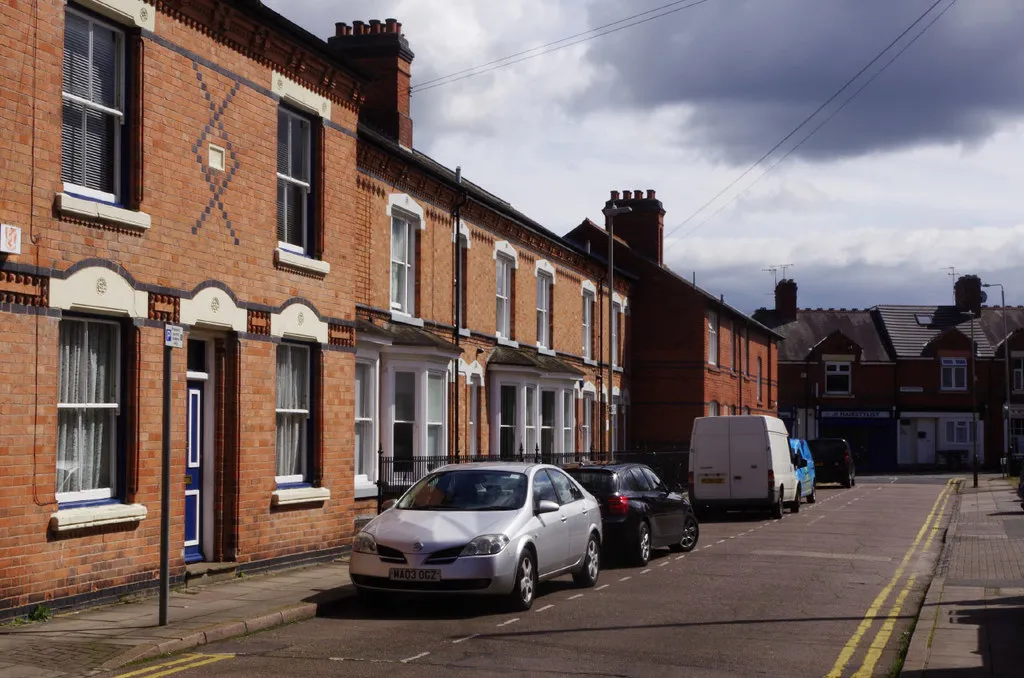
The Edwardian and railway-era stock (around 30% of Birstall's housing) is the legacy of the village's late-19th-century expansion driven by the Great Central Railway. Cavity-wall construction is standard from the 1920s onwards but is patchier on the earlier Edwardian (1900–1910) properties — survey-stage heat-loss calculation identifies whether solid-wall or cavity-wall is relevant for the specific property. Standard R32 monobloc heat pumps at 8–10 kW work well on the cavity-wall stock; the earlier Edwardian solid-wall stock typically calls for R290 systems.
Post-war 1950s–1990s estate stock (around 40% of housing) is straightforward cavity-wall retrofit territory — R32 monobloc systems at 7–9 kW, side-passage or rear-garden outdoor unit siting, two to four radiator upgrades on the larger rooms. Modern post-1990 stock (around 20%) is the easiest retrofit profile, with better insulation specs from new and radiators often already sized for lower flow temperatures.
The pre-1900 village core (around 10%) — the streets immediately around Church Hill and St James the Great — sits inside the CA boundary and carries the heaviest heritage constraint. Listed-building consent applies on individually listed properties separately from CA planning. The character of this stock is historic village (rather than suburban), with smaller plots, older construction, and potential listed-building constraints on adjacent properties.
Off-gas-grid status is worth flagging in Birstall. Although LE4 is connected to the mains-gas network for the main settlement, Birstall's village-suburban character and northern-periphery location relative to Leicester raise the possibility of off-grid or LPG pockets in dispersed parts of the area. Cadent, the gas network operator for the area, can confirm whether mains gas reaches a particular address, and the survey checks your current heating fuel. For confirmed off-grid properties currently on oil or LPG, the £9,000 grant rate (applications until 31 March 2027) is the relevant amount rather than the standard £7,500.
Beyond the residential streetscape, Birstall's character is shaped by Watermead Country Park (a series of recreational lakes on the village edge), the Great Central Railway heritage (the railway still operates as a steam line with the southern terminus nearby), Birstall Golf Club (established 1901, one of Leicestershire's earliest), and the medieval Church of St James the Great anchoring the village core. The cedar tree symbol — originally from the grounds of the demolished Birstall Hall — represents local heritage continuity.
For a Birstall heat pump installation, the practical sequence is: per-property planning check on the Charnwood BC portal (not the LCC portal — administrative jurisdiction matters), Cadent Gas Networks verification on off-grid status where relevant, free survey, R32 or R290 monobloc heat pump sized to the building (7–10 kW typical), two to five radiator upgrades depending on era, MCS-certified installation under PD or CA planning depending on CA status, BUS grant (£7,500 or £9,000 depending on existing fuel) applied by the installer on the homeowner's behalf, and commissioning. Three to six days on site, plus the CA planning timeline where applicable.
Heat pump services for Birstall
Most homes are on estates with easy siting; the village core around St James the Great is a conservation area. Our service pages explain each stage, and an enquiry through this site goes to one local installer from our network.
Paying for a heat pump in Birstall
Leicestershire County Council's Warm Homes scheme, which covers this area, is currently closed to new applications, but you can register interest through the government's Warm Homes: Local Grant service.
Otherwise, the Boiler Upgrade Scheme takes £7,500 off for any homeowner or private landlord, with no income test. Some properties on the edge of Birstall aren't on Cadent's gas network. If you heat with oil or LPG, the grant is £9,000 on applications by 31 March 2027. Details on our costs and grants page.
Estimated cost in Birstall
Birstall heat pump installations typically run £8,500–£12,000 before the £7,500 BUS grant — net £1,000–£4,500 (or net £0–£3,000 for confirmed off-grid properties on the £9,000 rate). That puts Birstall in the middle of the Leicester range, shaped by the village's 1899-Great-Central-Railway-era transformation and the subsequent expansion from 611 residents (1901) to over 11,000 by 2001.
Post-war 1950s–1990s estate stock. Around 40% of Birstall's housing — straightforward cavity-wall retrofit territory. £8,500–£10,000 gross. R32 monobloc heat pumps at 7–9 kW, side-passage or rear-garden siting, two to four radiator upgrades.
Edwardian and 1920s railway-era stock. Around 30% of housing — the legacy of the Great Central Railway's 1899 arrival. £9,500–£11,000 gross. Cavity-wall construction is standard from the 1920s onwards but patchier on earlier 1900–1910 Edwardian properties; survey-stage heat-loss calculation identifies cavity vs solid wall. R32 monobloc systems on the cavity-wall portion; R290 on the earlier solid-wall properties.
Pre-1900 village-core stock inside the Birstall CA. Around 10% of housing — the streets immediately around Church Hill and St James the Great, inside the April 1984-designated CA and within sight of the 5 Grade II listed structures. £10,500–£12,000 gross. R290 heat pumps for the higher flow temperatures solid-wall properties need, three to five radiator upgrades, and CA planning fees through the Charnwood BC portal (usually under £250). Listed-building consent applies on the church-adjacent properties separately from CA planning.
Modern post-1990 infill. Around 20% of housing — the easiest retrofit profile, with better insulation specs from new and radiators often already sized for lower flow temperatures.
Off-grid pricing path. For the dispersed Birstall properties confirmed off-grid by Cadent verification, the £9,000 BUS uplift materially improves the net picture — closing more of the gap to a like-for-like gas boiler swap.
After grant, the typical net Birstall installation sits £1,000–£4,500 (or £0–£3,000 at the £9,000 off-grid rate). Heat pump lifespan (15–20 years vs 10–15 for gas) and the gas-versus-electricity price trajectory close the gap further over the long run. Request a quote for a property-specific comparison; the 2026 heat pump cost guide breaks down the cost drivers.
Finding a good installer in Birstall
Check the company on the MCS register: without certification there's no grant. Be wary of cold calls offering free heat pumps; genuine free schemes run through the council.
Planning questions for Birstall go to Charnwood Borough Council. See finding a trustworthy installer and how we select installers.
Heat pump installation in Birstall — FAQ
How long does heat pump installation take in Birstall?
Most installations take three to five days at your home, after the survey and quote. Off-gas homes on the edge of the village need tank removal too.
Which planning authority covers Birstall?
Birstall falls under Charnwood Borough Council, the unitary authority for the borough. This is administratively separate from Leicester City Council — Birstall is just north of Leicester city's boundary, but in a different planning jurisdiction. All planning, conservation, and listed-building consent for Birstall properties go through Charnwood BC, with the planning portal at charnwood.gov.uk. Charnwood BC manages 38 conservation areas across the borough in total. Your installer carries out the per-property planning check on the Charnwood portal as part of pre-installation work.
Do I need planning permission for a heat pump in Birstall?
It depends on whether the property sits inside the Birstall Conservation Area. The CA was designated in April 1984; the character appraisal was adopted in March 2012. The CA is centred on St James the Great church on Church Hill, and contains 5 Grade II listed structures including the church itself. Inside the CA, external alterations on principal elevations need planning permission rather than relying on Permitted Development. Outside the CA — across the wider Edwardian, post-war, and modern stock that makes up most of Birstall — standard PD applies: the 1.5 m³ outdoor unit threshold, the MCS 020(a) noise standard at 37 dB LAeq,5min at the nearest residential window, and standard siting clearances.
Are heat pumps suitable for Birstall's railway-era and post-war housing?
Yes — most Birstall properties are heat-pump-suitable with the right specification. The defining housing-stock event was the arrival of the Great Central Railway in 1899, which drove the village's transformation from a rural settlement (611 residents in 1901) into a suburban centre (over 11,000 by 2001). The Edwardian-to-1920s railway-era stock (around 30% of housing) and the post-war 1950s–1990s estate stock (around 40%) are predominantly cavity-wall construction, which keeps heat-loss workable. Standard R32 monobloc heat pumps at 7–10 kW work well across most of the stock. Pre-1900 village-core stock (around 10%) inside the CA needs the more heritage-aware approach.
Am I eligible for the £7,500 BUS grant in Birstall?
Most homeowners and private landlords are. The grant is £7,500 with no income test, or £9,000 if you heat with oil or LPG (applications by 31 March 2027). Lower-income households may qualify for free Warm Homes funding instead.
How much does heat pump installation cost in Birstall?
Roughly £8,500–£12,000 before the grant and £1,000–£4,500 after it. Radiators, the cylinder and any microbore pipework make the biggest difference.
What about the Birstall Conservation Area and listed buildings?
The Birstall Conservation Area was designated in April 1984 and centres on St James the Great church on Church Hill. The CA's character appraisal was adopted in March 2012 — that's the document any heat pump installation inside the CA needs to reckon with. The CA contains 5 Grade II listed structures including the church itself; the other four are not individually identified in the published Charnwood material. Inside the CA, external alterations on principal elevations need planning permission. Listed buildings always need listed-building consent regardless of PD. The CA's exact street-level boundary needs per-property verification via the Charnwood BC planning portal.
Will I need new radiators with a heat pump in a Birstall home?
Some, most likely. Railway-era terraces need more radiator work than post-war homes. Larger radiators let the heat pump run at a lower, more efficient temperature.
Get a Birstall heat pump quote
Submit the form on the homepage with your LE4 postcode and a note about your property. We'll route the enquiry to an installer in our network whose coverage of Birstall and brand portfolio fit. The survey is free; the written quote shows the actual figure you'd pay after the £7,500 BUS grant has been deducted, with any required radiator upgrades or hot water cylinder costs included.